

Description
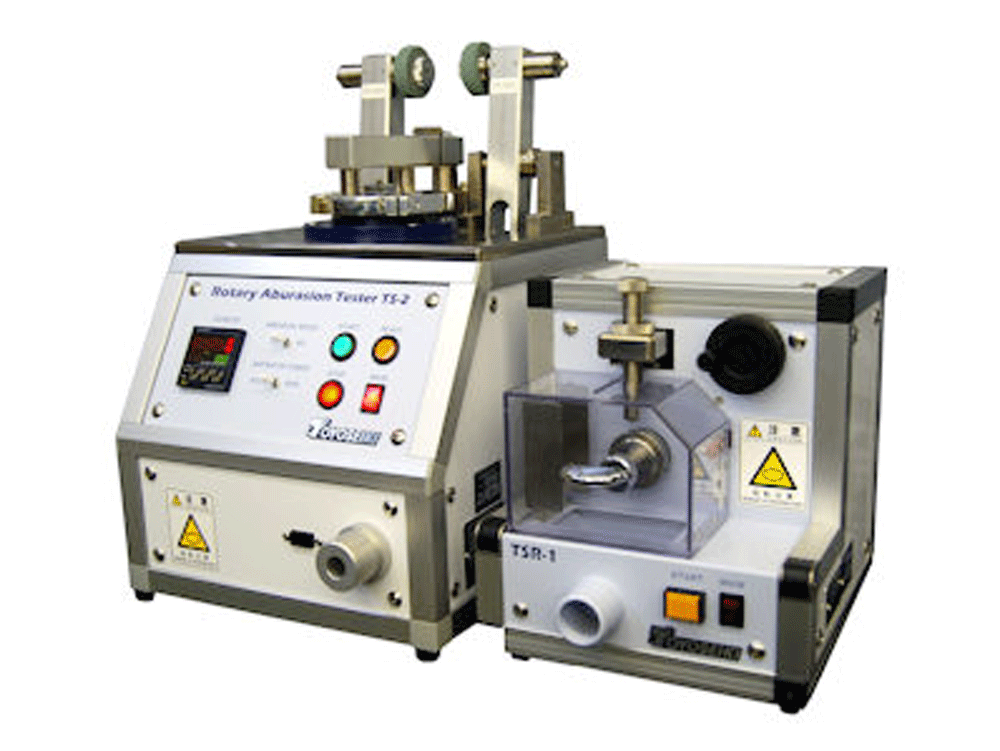
Taber Abraser became a global benchmark for evaluating abrasion resistance because it can reproduce rub-wear action quickly and consistently. The “Taber Test” mounts a flat specimen to a rotating turntable. As the platform turns, two abrading wheels contact the surface to create a characteristic crossed-arc abrasion pattern, while the integrated vacuum pickup removes loose debris during the test to improve repeatability.
The Model 1700 / 1750 generation is engineered for quality and reliability, combining a modern LCD touchscreen interface with practical design improvements such as a redesigned support frame and housing, compact abraser arm assemblies, and a quick-release wheel mounting hub for easier wheel changes and better access to the specimen area. The direct-flow vacuum nozzle includes precision height adjustment and screw-in nozzle tips (8 mm and 11 mm), helping users maintain proper vacuum pickup performance across varying sample setups.
Taber Abrasers are widely used for wear and abrasion research, materials evaluation, product development, and production quality/process control. Their application spans coatings and plated finishes, textiles and carpets, plastics, rubber, laminates, paper, glass, ceramics, metals, and more which making them a versatile solution for multi-industry abrasion testing programs.
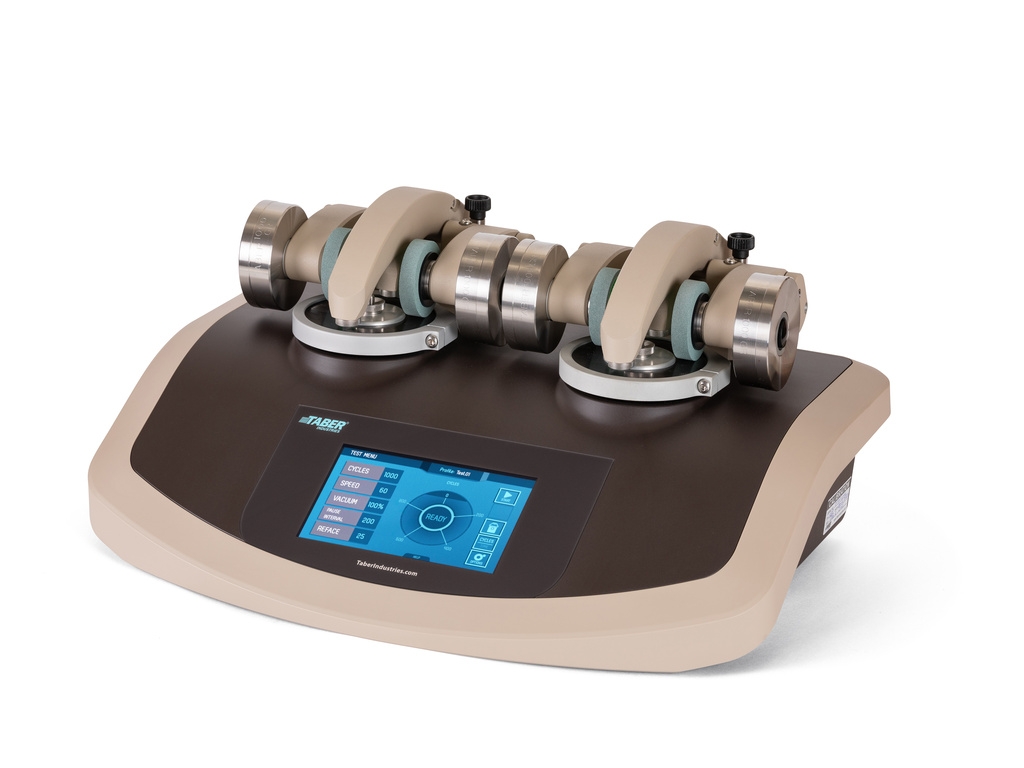
Also available in a dual head model features two sample turntables, allowing two tests simultaneously (test two different or identical specimens for comparison or contrast).
Separate function keys operate the turntables independent of each other.
Key Features
-
Rotary platform abrasion test with dual abrading wheels
-
LCD touchscreen operator interface with intuitive navigation
-
Selectable turntable speeds: 60 rpm and 72 rpm
-
Integrated vacuum system for debris removal
-
Adjustable vacuum nozzle height for different specimen thicknesses
-
Quick-release wheel mounting hub for easy wheel changes
-
Compact, precision-balanced abraser arm assemblies
-
Standard wheel load of 250 g, expandable to 500 g or 1000 g using auxiliary weights
-
Available in single- or dual-platform configurations
Specifications
-
Test Method: Rotary platform abrasion
-
Specimen Format: Flat square or round specimens
-
Standard Specimen Thickness: Up to 6.35 mm
-
Extended Thickness (with accessories): Up to 40 mm
-
Turntable Speeds: 60 rpm / 72 rpm
-
Standard Load: 250 g per wheel
-
Optional Loads: 500 g / 1000 g
-
Vacuum System: Integrated with adjustable nozzle
-
Control Interface: Touchscreen LCD
Model Variants:
-
Model 1700: Single specimen turntable
-
Model 1750: Dual specimen turntables (independent operation)
Applications
-
Quality and process control
-
Research and development
-
Comparative material evaluation
-
Coatings and surface finishes
-
Plastics and polymers
-
Textiles, fabrics, and carpets
-
Leather and rubber
-
Paper, laminates, and packaging materials
-
Ceramics, glass, stone, and metals
Accessories & Options
-
Genuine Taber abrading wheels (various grades)
-
Auxiliary weight sets
-
Counterweight kits
-
Specimen holders and mounting fixtures
-
Wheel refacing tools
-
Sample cutters
-
Grit feeder attachment
-
Scuffing head attachment
-
Calibration and verification kits
-
Quiet cabinet enclosur
STANDARDS
ASTM
-
ASTM D4060 – Abrasion Resistance of Organic Coatings (Taber Abraser)
-
ASTM D3884 – Abrasion Resistance of Textile Fabrics (Rotary Platform, Double-Head)
-
ASTM D1044 – Resistance of Transparent Plastics to Surface Abrasion
-
ASTM D3389 – Coated Fabrics Abrasion Resistance
-
ASTM D7255 – Abrasion Resistance of Leather
-
ASTM C501 – Abrasion Resistance of Unglazed Ceramic Tile
-
ASTM C1353 – Abrasion Resistance of Dimension Stone
-
ASTM F1978 – Abrasion Resistance of Metallic Thermal Spray Coatings
-
ASTM G195 – Guide for Wear Tests Using a Rotary Platform Abraser
-
ASTM B1023 – Abrasion Resistance of Hard Anodic Coatings
-
ASTM B607 / B733 – Abrasive Wear of Autocatalytic Nickel Coatings
EN / BS / DIN / European Standards
-
EN 438-2 – Decorative High-Pressure Laminates (HPL)
-
EN 13329 – Laminate Floor Coverings
-
EN 13672 – Synthetic Turf Abrasion Resistance
-
EN 13696 / EN 14354 – Wood & Veneer Flooring Wear Resistance
-
EN 660-2 – Resilient Floor Coverings (Frick-Taber Method)
-
BS 3900 (ISO 7784 equivalent) – Abrasion Resistance of Paints & Varnishes
-
DIN 52 347 / DIN 53 754 – Abrasion Resistance of Plastics & Glass
-
DIN 68 861 – Furniture Surface Abrasion
- DIN EN ISO 17076-1 – Textile
ISO
-
ISO 5470-1 – Abrasion Resistance of Rubber or Plastic-Coated Fabrics
-
ISO 7784-1 / 7784-2 – Abrasion Resistance of Paints and Varnishes
-
ISO 9352 – Abrasion Resistance of Plastics by Abrasive Wheels
-
ISO 10074 – Hard Anodic Oxidation Coatings on Aluminum
-
ISO 15082 – Safety Glazing Materials (Abrasion Resistance)
-
ISO 24338 – Abrasion Resistance of Laminate Floor Coverings
-
ISO 3537 – Road Vehicle Safety Glazing Materials
NWSP
- NWSP 020.4.RO
Military, Aerospace & Industrial Specifications
- MIL-A-8625 – Anodizing & Coatings
- MIL-PRF-24712 – Anodizing & Coatings
-
MIL-PRF-32170 – Anodizing & Coatings
Automotive & Transportation Standards
-
ANSI / SAE Z26.1 – Safety Glazing Materials (Plastics & Glass)
-
SAE J948 – Abrasion Resistance of Automotive Fabrics, Vinyl & Leather
-
SAE J1530 – Automotive Carpet Abrasion
-
SAE J1847 – Vehicle Exterior Graphics & Pin Striping
-
ECE Regulation 43 – Safety Glazing Materials
Textiles, Leather & Flooring
-
ISO 5470-1 / ASTM D3884 – Textile Abrasion
-
ASTM D4685 – Corduroy & Pile Fabrics
-
JIS L 1096 / JIS L 1021 – Woven & Textile Floor Coverings
-
NALFA LF-01 – Laminate Flooring Abrasion Classification
-
TAPPI T476 – Paper & Paperboard Abrasion Resistance
Plastics, Laminates & Decorative Surfaces
-
ANSI INCITS 322 – Plastic ID & Credit Cards (Surface, Image, Barcode, Magnetic Stripe)
-
NEMA LD-3 – High-Pressure Decorative Laminates
-
CPA WR-01 – Decorative Laminated Surfaces
Videos
BROCHURE